Mole Tunnels on the Ground stock photo Image of tracks Biology Diagrams Moles are primarily carnivores, subsisting mainly on earthworms, grubs, and other insects that live in the soil. They spend most of their lives underground, digging extensive tunnel systems in their search for food. These tunnels are often close to the surface and can cause raised ridges in your lawn, which are the most common sign of a mole
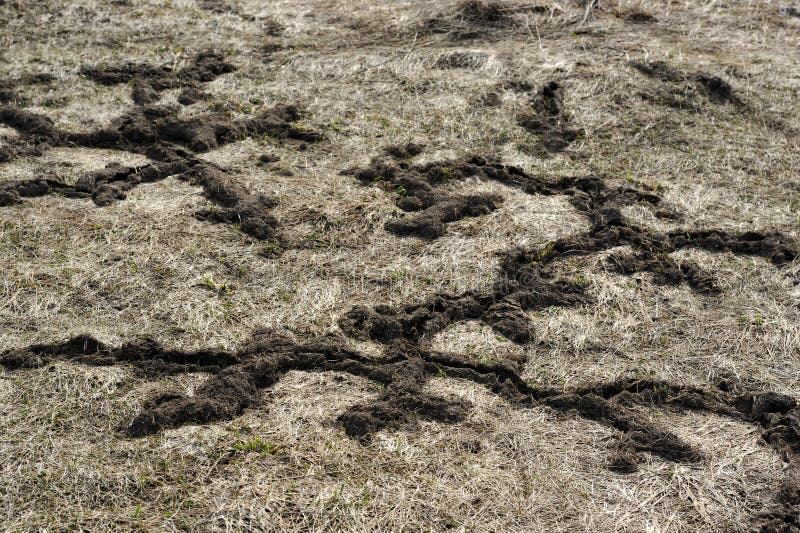
Locate active tunnels by stomping down mole hills in the day. Check the next morning for new hills, which indicate active tunnels immediately under. Probe 6-18 inches from the center of the mole hill for tunnels; a long screwdriver or steel rod will suffice. If the probe suddenly drops a couple of inches, you have found a tunnel. Probe again to
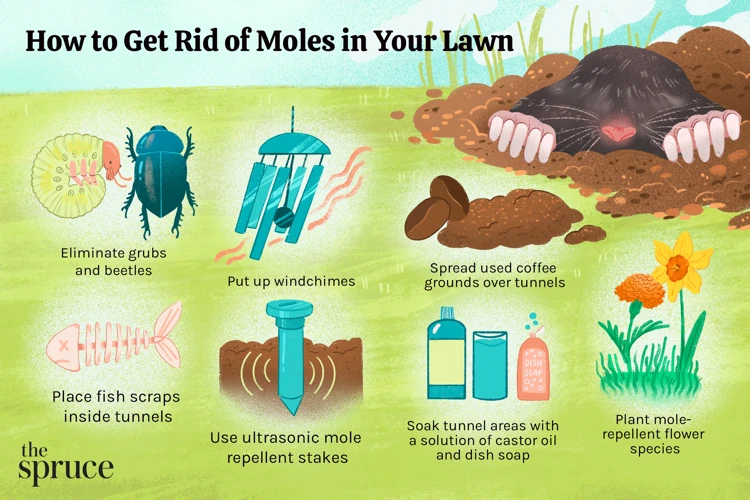
The Environmental Literacy Council Biology Diagrams
Generally, they grow to be 6 to 8 inches long including their tail. Moles use their front claws for digging their tunnels. They create their tunnels continuously and may not use the same tunnel for twice. They prefer to spend most of their time alone underground into their tunnel. They create tunnels mainly in order to search for their foods.

MANAGEMENT OF MOLES y Victoria Wallace and Alyssa Siegel-Miles, Uonn Extension Moles play an important role in the ecosystem food chain, serving as both predators and prey. They are a common staple in the diets of hawks, owls, and snakes. Moles are insectivores that feed on invertebrates, primarily earth-worms and insects (including grubs).

Complete Diet List - Pest Breaker Biology Diagrams
The long snout also helps moles to locate their foods easily. The large, curved claws on the toes of their front feet are adapted for burrowing and they can dig underground tunnels as long as 18 cm in just one hour. Behavior Moles are solitary creatures from the day they leave their mothers, only coming together at mating periods. Moles constantly search for food by digging tunnels underground day and night. They continuously operate for a few hours at once and then rest for the same amount of time. They have to eat once every few hours; otherwise, they will die of starvation. They eat slugs, earthworms and beetle larvae found in tunnels while digging. Typically, only two to three moles will share the same tunnel system. They require a large territory to find sufficient food. 14. Do moles reuse their tunnels? Moles create a system of deep, more permanent tunnels that they reuse. They also create temporary surface runs for feeding. 15. What does a mole-infested yard look like? A yard with mole
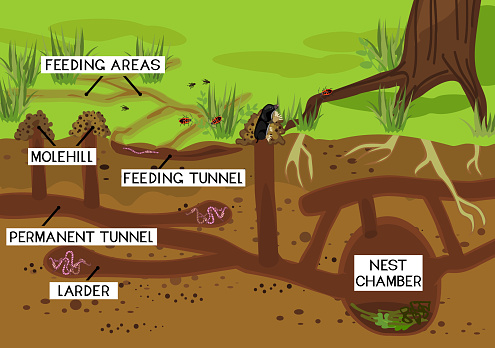
Moles construct intricate underground tunnels that serve multiple purposes, including feeding, nesting, and navigation. These tunnels are a hallmark of mole activity and often reveal their presence in lawns and gardens. Physical Characteristics: Larger than moles, with external cheek pouches for carrying food. Behavior: Create deep tunnels
